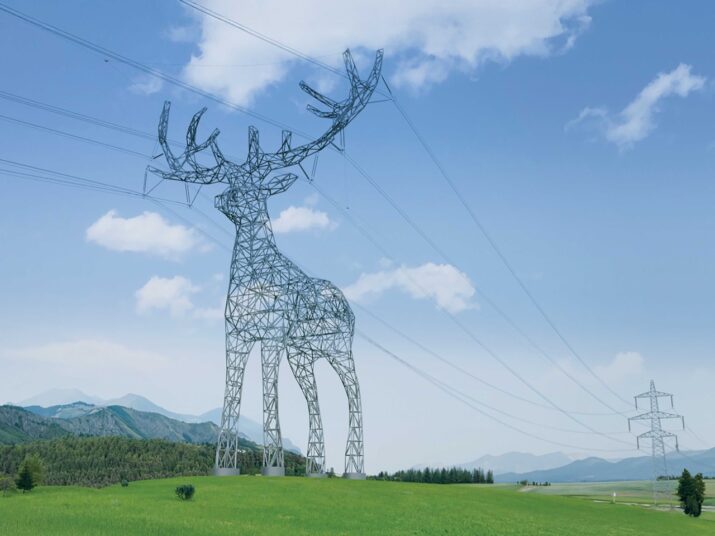
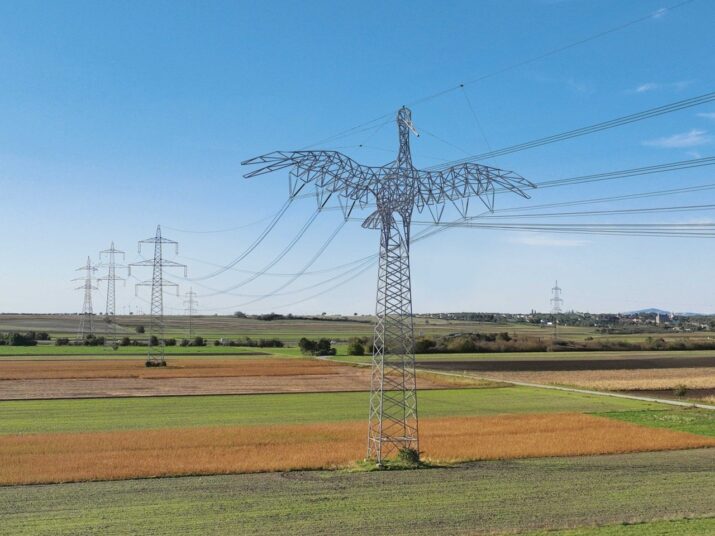
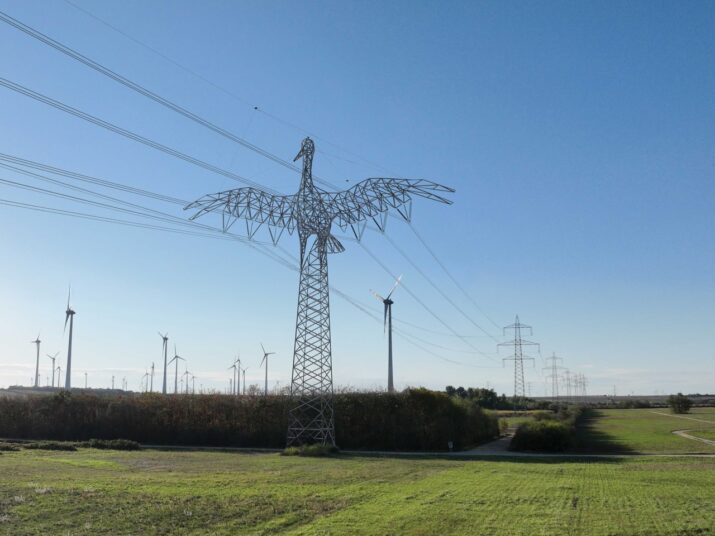
But here’s the thing: Austrian Power Grid didn’t just approve of these designs willy-nilly, they actually engineered these. The stork and stag pylons have been pre-tested for structural stability and high-voltage performance, which means this isn’t vaporware concept art destined to die in a Behance portfolio. They’ve brought in Baucon as the construction partner, Robert Glas handled statics, and GP-Design (Roland Kaufmann) tackled the aesthetics. The team is led by Paul Japek with engineering from Christoph Mathe and Philipp Bader, so there’s real technical muscle backing the vision. This won in the Electrification and Decarbonisation category, and given how much resistance grid expansion faces across Europe, the timing feels deliberate.
Austria has nine states, and each one gets its own animal: a stork for Burgenland’s migratory routes, a stag for the Alpine regions of Lower Austria. The silhouettes are rendered in the same lattice framework you’d see on any transmission tower, maintaining the load-bearing logic while reshaping the profile into something recognizable from kilometers away. What strikes me is how the forms don’t fight the engineering; the antlers of the stag pylon double as crossarms for the power lines, and the stork’s wings naturally extend outward to support cable spans. It’s a rare case where aesthetics and function actually converge instead of one compromising the other.
The real test will be public reception once these go live. NIMBY opposition to grid infrastructure is fierce, especially in rural and scenic areas where people (understandably) don’t want their views dominated by industrial metal. Austrian Power Grid is betting that regional pride and visual interest can shift that calculus. If a community sees a pylon as a landmark rather than an eyesore, the theory goes, acceptance follows. Whether that plays out in practice depends on execution, but the images so far are striking enough that I think they’re onto something here.